

















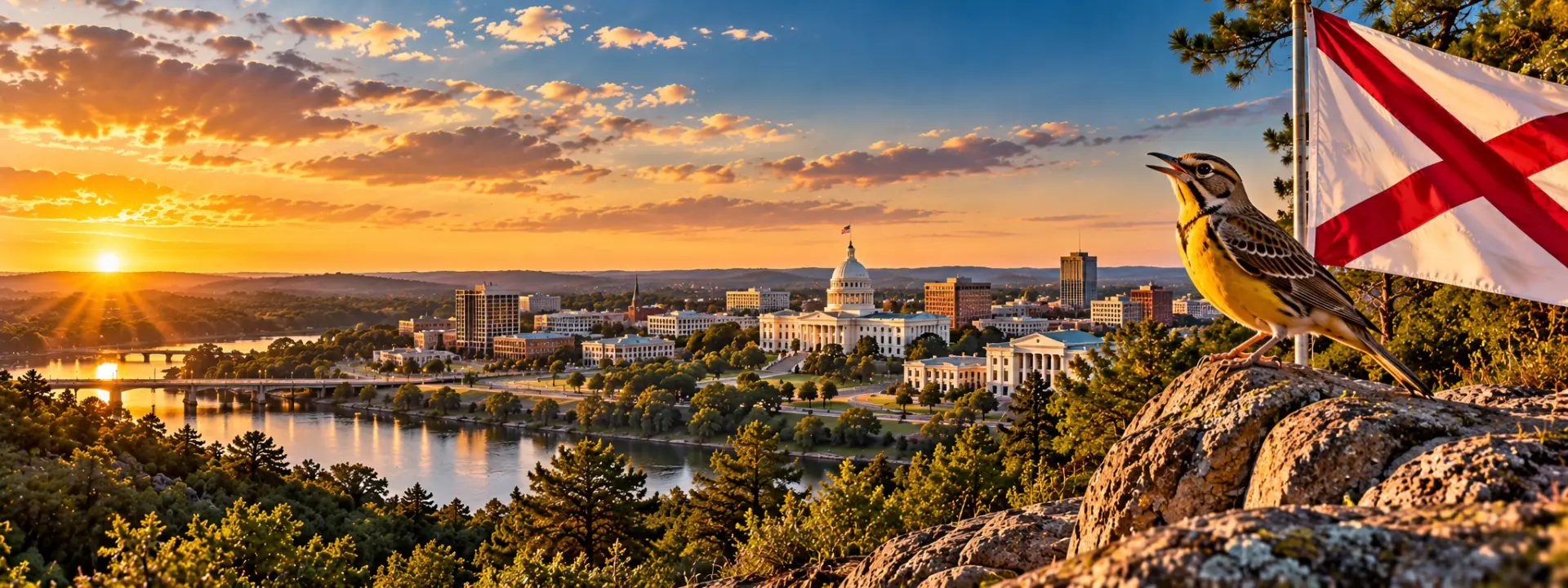
Panoramic landscape of Alabama with its state flag

Alabama

Alabama is a Deep South state with a manufacturing-driven economy anchored by automotive plants, aerospace research in Huntsville, and steel production in Birmingham. It played a central role in the Civil Rights Movement, with landmark events in Montgomery and Selma. Alabama has one of the lowest costs of living in the country alongside relatively low incomes and significant rural poverty. Its culture blends Southern cuisine, college football rivalries and a deep religious tradition rooted in the Bible Belt.

Capital: MontgomeryLargest city: HuntsvilleNickname: The Yellowhammer StateStatehood: 1819

Alabama at a glance

The state’s essential figures from the latest official data

Area
135,767 km²
30th largest state
Population
5,157,699
39.3 people/km² of land
July 1, 2024 · 24th in the U.S.
Foreign-born population
3.8%
Share of all residents
ACS 2019–2023
GDP
$339 billion
$59,754 personal income per capita
2025 · BEA
Births
57,541
July 2023–June 2024
Deaths
59,273
July 2023–June 2024
Natural increase
−1,732
Births minus deaths
Population change
+40,026
July 2023–June 2024

Alabama data modules

Official information organized by subject

Population

How many people live here, how it's changing and who they are.

Housing

Home prices, rents, supply and how affordable it is to live here.

Economy

GDP, income, output and the industries that drive the economy.

Cost of Living

What it really costs to live here: housing, food, utilities and more.

Jobs & Employment

Employment, unemployment, salaries and the labor force.

Crime & Safety

Crime rates, violent and property crime, and public safety.

Education

Schools, universities, attainment and graduation rates.

Health

Life expectancy, healthcare access, hospitals and insurance.

Taxes

Income, property and sales taxes, plus overall tax burden.

Immigration

Foreign-born population, origins and migration flows.

Energy

Electricity prices, production, renewables and consumption.

Environment

Air quality, wildfires, drought, water and emissions.

Transportation

Vehicles, public transit, airports, traffic and commuting.

Politics & Elections

Election results, representatives and voting trends.

Poverty & Welfare

Poverty, food assistance, Medicaid and social safety net programs.

Retirement & Seniors

Older population, Social Security, retirees and senior living.

Agriculture & Farming

Farms, farmland, crop and livestock output and agricultural exports.

Tourism & Parks

Visitors, tourism spending, national and state parks.

Innovation & Patents

Patents, R&D spending, venture capital and tech employment.

Culture, Media & Gaming

Film, TV, music, theaters, museums and the video game industry.

Pets & Animal Welfare

Pet ownership, shelters, adoptions and veterinary services.

Explore Alabama

67 counties, one interactive atlas

Select a county to compare population, income, housing and territory using official U.S. Census Bureau data.

Autauga County · 59,285 residentsBaldwin County · 239,945 residentsBarbour County · 24,757 residentsBibb County · 22,152 residentsBlount County · 59,292 residentsBullock County · 10,157 residentsButler County · 18,807 residentsCalhoun County · 116,141 residentsChambers County · 34,450 residentsCherokee County · 25,224 residentsChilton County · 45,500 residentsChoctaw County · 12,525 residentsClarke County · 22,802 residentsClay County · 14,188 residentsCleburne County · 15,254 residentsCoffee County · 54,231 residentsColbert County · 57,648 residentsConecuh County · 11,411 residentsCoosa County · 10,323 residentsCovington County · 37,647 residentsCrenshaw County · 13,144 residentsCullman County · 89,463 residentsDale County · 49,516 residentsDallas County · 37,536 residentsDeKalb County · 71,946 residentsElmore County · 88,669 residentsEscambia County · 36,695 residentsEtowah County · 103,208 residentsFayette County · 16,173 residentsFranklin County · 31,978 residentsGeneva County · 26,726 residentsGreene County · 7,589 residentsHale County · 14,749 residentsHenry County · 17,450 residentsHouston County · 107,628 residentsJackson County · 52,839 residentsJefferson County · 669,744 residentsLamar County · 13,809 residentsLauderdale County · 95,037 residentsLawrence County · 33,182 residentsLee County · 177,663 residentsLimestone County · 107,577 residentsLowndes County · 10,008 residentsMacon County · 18,951 residentsMadison County · 397,135 residentsMarengo County · 19,027 residentsMarion County · 29,190 residentsMarshall County · 98,712 residentsMobile County · 413,162 residentsMonroe County · 19,580 residentsMontgomery County · 227,197 residentsMorgan County · 123,742 residentsPerry County · 8,231 residentsPickens County · 18,843 residentsPike County · 32,953 residentsRandolph County · 22,310 residentsRussell County · 58,858 residentsShelby County · 226,955 residentsSt. Clair County · 92,903 residentsSumter County · 12,020 residentsTalladega County · 81,170 residentsTallapoosa County · 41,070 residentsTuscaloosa County · 234,036 residentsWalker County · 64,886 residentsWashington County · 15,270 residentsWilcox County · 10,347 residentsWinston County · 23,637 residents
Population (residents)
< 50,000> 3,000,000

Alabama, United States

Jefferson County

County seat: Birmingham

669,744
Population
$39,826
Income per capita
$224,900
Median home value
4.8%
Unemployment
Land area
1,112 mi²
Population density
603 /mi²

ACS 2023 5-year estimates · Census Gazetteer 2023. Unemployment is calculated from the ACS civilian labor force.

Counties

67 counties · choose how to order them

Did you know?

Curious facts about Alabama

The rocket city

Huntsville's Marshall Space Flight Center developed the Saturn V rocket that carried Apollo astronauts to the Moon; a full Saturn V is displayed at the U.S. Space & Rocket Center.
Birthplace of civil rights milestones

The 1955–56 Montgomery Bus Boycott, sparked by Rosa Parks, and the 1965 Selma-to-Montgomery marches both took place in Alabama.

A river system rich in life

Alabama's rivers hold more species of freshwater fish, mussels, snails and turtles than any other state.

Mardi Gras came first to Mobile

Mobile held the first organized Carnival celebration in what is now the United States, dating back to the early 1700s.